


With the rise in the popularity of electric vehicles in the United States, many motorists will question the feasibility of issues such as the speed of charging. The knowledge of EV charging time USA is critical in trip planning, energy charges estimation, and the ability to have a comfortable driving experience. The issue of charging is no longer a technical detail but the issue that directly affects the convenience and time scheduling as well as the overall possibility of replacing vehicles that operate on gasoline.
EVs that can travel farther are also available in 2025, but the rate at which the vehicle can be charged is also an important factor to American drivers in cities, suburbs, and rural enclaves. There are those drivers that use home charging and others use public fast it on highways.
The EV Charging Time Factors USA
The factors that affect the EV charging time USA include the battery size, state of charge and the type of charger. Naturally larger batteries can be filled slower and the charging rate is not necessarily linear. Weather and temperature are also contributing factors and extreme temperatures, either hot or cold, may reduce charging efficiency. Also, the battery age and health influences the rate at which it can receive a it. Knowledge of these factors enables drivers to be more realistic in their charging timelines and be better planners in terms of making a trip.The other factor is the charging infrastructure in your area.
Cities tend to have more fast chargers, and rural ones might need to be more dependent on slower Level 2 chargers at home or in the community. Such variables ensure that EV charging time in the USA is not a fixed value, but a dynamic parameter, and a real-life experiment is essential to get the planning right.
Learning Level 1 Charging
Level 1 charging involves a regular 120-volt household outlet, which is the slowest way of charging an EV. Level 1 chargers can provide approximately 2-5 miles of range per hour, and so a full its may take 12-40 hours based on the size of the battery. Level 1 charging is not suitable in long-distance travel though it is comfortable when charging over night and taking short commutes daily.
Level 1 charging is appropriate to many American households whose drivers travel less than 40 miles in a day. But those that intend on taking longer journeys or increased daily mileage ought to look at the faster options. Level 1 charging can be considered a reference color in getting the picture of EV charging time in the USA even though the charging is slow.
Level 2 Charging: The Home and Public Choice
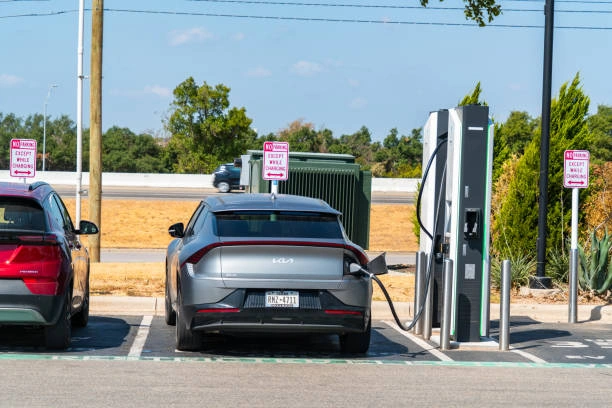
Level 2 chargers use 240 volts and usually are placed in residential houses, workspaces, and externally. They save a lot of time in charging as compared to Level 1. Level 2 charging provides between 15 and 30 miles of range per hour on average and in most cases, a full of most EVs takes between 4 and 10 hours according to the size of the battery.
Level 2 charging has the following advantages:
This is because it charges faster than the conventional points.
- Fits with the majority of contemporary EV.
- Usable either at home or at work.
Due to the convenience and speed, one of the most feasible solutions is Level 2 charging as far as EV charging time USA is concerned with the daily usage.
DC Fast Charging: Quick Charging of Long-haul Travel
The highest-speed public charging option available is the DC fast chargers, otherwise known as Level 3 chargers. The chargers are able to recharge 80 percent of a battery within 20 to 45 minutes, as per the EV model and battery size. The cross-country trips can be made convenient as fast chargers are specifically critical when it comes to travelling along the highways and making stops regularly without long stops. A large number of EVs of the year 2025 will be compatible with high-power DC fast charging with a significant reduction in downtime when compared to home chargers.
The drivers are encouraged to remember that DC fast charging can become hot when used regularly and cause a slight increase in battery wear and tear. Nevertheless, fast charging is an essential element of the U.S. EV system, particularly in long-range travel, where the Level 1 or Level 2 charging would be inconvenient.
Factors in real-life that are involved in charging times
Although the type of chargers is crucial, other real-life aspects influence EV charging time in the USA. Real performance is affected by battery state of charge, battery temperature and battery usage patterns. Extreme weather may cause lower charge rates to drivers, and large-battery vehicles will take longer to charge to full.
Other practical implications are:
- Battery pack age and health.
- Local variations in the supply of electricity.
- Power output and charger compatibility.
Taking these variables into account makes drivers have their perspective and organize trips effectively. The experience of EV charging time in the USA can differ, though, with proper planning, the EVs can address the requirements of the daily commuters and long-range travels alike.
The Electric infrastructure in the USA
Availability is charged in very different ways. The city of Los Angeles, New York, and Chicago boasts of high density of Level 2 and DC fast charging stations, whereas the countryside may have a smaller number of charging stations. This difference impacts EV charging time in the USA, as in certain areas, the drivers might have to depend more on slower Level 2 chargers at home or at the places of worship.
Both federal and state programs are actively increasing the charging infrastructure, minimizing the range anxiety and making the use of EVs more realistic. In areas that have an excellent infrastructure, the time taken to charge a vehicle is much less whereas planning is vital in areas with few chargers.
How to reduce EV Charging Time USA
Some measures that can be implemented by drivers to ensure maximum charging speed and efficiency include minimizing downtime. A lot of these measures are not complex yet effective which make EV experience and convenience better.
- Electricity should be charged during low peak hours to avoid straining the electrical grid.
- Always precondition the battery before charging to achieve maximum speed.
- Whenever making a long trip rely on Level 2 or DC fast chargers.
Through such practices, EV charging time in the USA can be more predictable and controllable in the life of everyday drivers or traveling by EVs over a long distance.
Conclusion
The knowledge of EV charging time USA is critical to any individual thinking of the ownership of electric vehicles in the United States. The speed of charging is dependent on the size of the battery, the type of charger and environmental conditions, although modern EVs have several convenient choices. Level 1 chargers can be used on the daily commuting that is small, Level 2 chargers can be used practically in the home and workplace, and DC fast chargers can be used to have fast long-range travel. As the infrastructure grows and the battery technology improves, drivers will have an opportunity to plan their destinations and day to day activities.
